



How foreigners should read and check rental agreements.

Once you've found your ideal property in Japan to live in, it's time to proceed with the contract.
To avoid problems after moving in and when moving out, it's important to thoroughly understand the contents of the contract.
Therefore, this article will explain how to read and check the contract and important matters explanation document (Jusetsu) in Japanese real estate contracts.
Please use this as a reference to help you start your life in Japan with peace of mind.
1.What is a Japanese rental contract?
A rental agreement is a contract between a landlord and a tenant.
In English, this is called a "Lease Agreement."
It summarizes information about the property, contractual obligations, rules, etc., and once both parties sign and stamp the document, they are deemed to have agreed to the contract.
Therefore, it is important to fully understand the contents before signing.
2.How to read a rental contract and check points

Rental agreements vary in format depending on the real estate company.
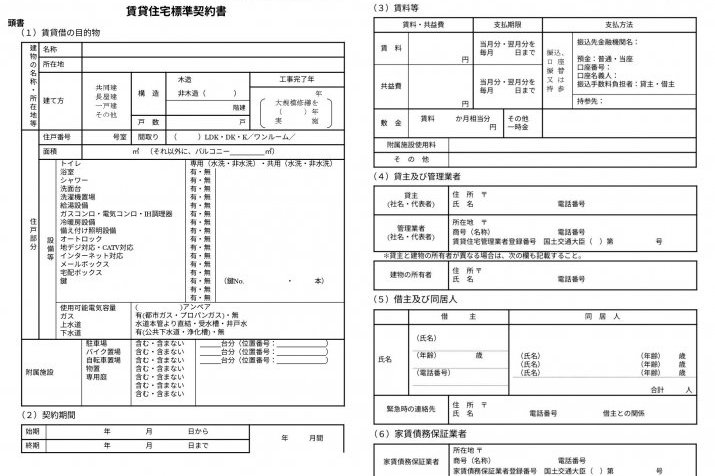
Therefore, here we will look at each item using the sample rental agreement from the " Guidelines for Facilitating Foreigners' Access to Private Rental Housing " published by the Ministry of Land, Infrastructure, Transport and Tourism as a reference.
(Within the guidelines, you can refer to sample contracts in various languages, including English and Chinese.)
Since important information disclosure documents are often issued only in Japanese, it is recommended to either request a translation or choose a real estate company that offers foreign language support.
① The object of the lease
This section clearly outlines the basic information about the property and its intended use.
[Main contents]
- Building name and location, etc.: The exact name and location of the property, the type of building (apartment, house, etc.), structure, etc.
- Residential unit: Floor plan, area, and presence or absence of built-in amenities.
- Additional facilities: such as the presence or absence of parking or storage sheds.
[Checkpoint]
- In typical rental agreements in Japan, it is prohibited to use the rented room for purposes other than residential use (such as an office or shop).
- To avoid problems, be sure to check the availability and conditions of the facilities before signing the contract.
② Contract period
The contract period for the property you are renting is clearly stated.
[Main contents]
- Contract start date and end date
[Checkpoint]
- In Japan, the typical lease term for rental housing is two years.
- Before signing the contract, be sure to check whether it's possible to renew it after the contract period ends if desired.
③Rent, etc.
The monthly rent and other expenses are clearly stated.
[Main contents]
- Rent: Monthly rent
- Common area maintenance fee: The amount that includes the maintenance and management costs of common areas (cleaning fees, utilities, etc.).
- Security deposit: If there is a deposit held to cover unpaid rent or costs for restoring the property to its original condition upon vacating, the amount will be listed.
- Other one-time payments: If there are any one-time payments to be made at the time of signing the contract, such as key money or brokerage fees, the item and amount will be listed.
- Facility usage fees: If there are fees for using facilities such as parking lots or bicycle parking areas, the item and amount will be listed.
- Other: If there are any other expenses to be paid besides those listed above, the items and amounts will be listed.
[Checkpoint]
- Your monthly payments will include "rent + utilities + α". Make sure to carefully check the total amount you will be paying each month.
- The security deposit, key money, and brokerage fee are paid only once upon moving in. Since these constitute a significant portion of the initial costs, be sure to carefully check the total amount.
④ Landlord and property management company
This section clarifies who the property owner and manager are in the lease agreement.
[Main contents]
- Landlord: Information about the property owner
- Property Management Company: Information about the company that manages the property on behalf of the landlord.
[Checkpoint]
- These can also serve as emergency contact numbers. Be sure to keep them carefully recorded.
⑤ Tenant and cohabitant
This document clarifies information regarding the tenant and co-occupants in a rental agreement.
[Main contents]
- Borrower: Information about the borrower who is a party to the contract.
- Roommates: If there are roommates, please provide that information.
[Checkpoint]
- In Japanese rental agreements, cohabitation without permission is generally considered a breach of contract, even if it's with a partner or family member. If you have a cohabitant, you must declare it when signing the contract, and you must also notify the landlord if the number of cohabitants increases after you move in.
⑥ Rent guarantee companies
If a rent guarantee company (guarantee provider) is used to cover situations where the tenant is unable to pay the rent, that information will be clearly displayed.
[Main contents]
- Information about the guarantee company
[Checkpoint]
- In Japanese rental agreements, a "guarantor" is required to pay the rent if the tenant is unable to do so. Generally, a guarantor must be a relative living in Japan with a stable income, which can be difficult for foreigners to find.
*The information explained so far is based solely on a sample contract provided by the Ministry of Land, Infrastructure, Transport and Tourism. When reviewing an actual contract, be sure to carefully check the entire document, including any "special clauses."
3.The difference between a lease agreement and an important matters explanation document.

In Japan, when entering into a rental agreement, not only the contract itself but also an important information document is exchanged.
An important matters explanation document is a document that explains important points before signing a rental contract so that the contract can be concluded without any problems.
The explanation of important matters is mandated by law and helps those entering into a contract to fully understand "what kind of property it is" and "what the terms of the contract are" before signing.
At the same time, this document also serves to prevent situations where someone claims they were "not informed" after the contract has been signed.
To summarize briefly, the contract is the content of the promise, and the important points are a detailed explanation of that promise.
4.How to read the Important Information Explanation Document and check points

An English sample of the Important Information Explanation Document is also provided in the " Guidelines for Facilitating the Occupancy of Private Rental Housing for Foreigners ."
There are some parts that overlap with the rental contract, but we will explain the points you should check in particular.
Status of drinking water, electricity, gas supply facilities and drainage facilities
Information regarding essential services such as electricity, water, and gas is clearly displayed.
[Main contents]
- Status of electricity, water, and gas facilities
[Checkpoint]
- Check whether utilities (mainly gas) are already installed or if you need to contract them yourself.
Amounts received in addition to rent
The items you need to pay in addition to rent, and the amounts for each, are clearly stated.
[Main contents]
- Security deposit, key money, brokerage fee, common area maintenance fee, etc.
[Checkpoint]
- Basically, it's the same as what's shown in the contract, but you should also check that the items and amounts in the important matters explanation document are correct.
Matters regarding contract termination
The circumstances under which the contract can be terminated are clearly stated.
[Main contents]
- The circumstances under which the landlord can terminate the contract. Examples include non-payment of rent, using the property for purposes other than those intended, prohibited activities, etc.
- Conditions under which the tenant can terminate the contract
[Checkpoint]
- If a tenant engages in any conduct that violates the terms of the contract regarding termination, the tenant must vacate the property.
- If a tenant wishes to move during the contract period, in most cases they can terminate the contract early by giving 30 days' notice and paying the rent for that period.
Restrictions on use and prohibitions
The scope of tenants and cohabitants is clearly stated in the contract.
[Main contents]
- Procedures and risk of breaching contract when more people live together
[Checkpoint]
- Check for restrictions on use (such as whether the space is for residential use or not, and whether pets and musical instruments are allowed). Be aware of penalties for violations.
Matters concerning the settlement of security deposits, etc.
The terms and conditions for refunding the security deposit and their contents are clearly stated.
[Main contents]
- Restoration of the property to its original condition: This stipulates the condition in which the tenant must return the property to the landlord at the end of the lease agreement.
- Cost burden: Who will bear the cost of restoring the property to its original condition and at what rate?
[Checkpoint]
- Under Japanese lease agreements, tenants are usually obligated to restore the property to its original condition when they move out. However, this does not include wear and tear due to aging or normal use.
- Details regarding restoration to the original condition are also listed in the "Appendix" of the rental contract. Please keep the rental contract and the Important Information Explanation in a safe place to avoid any problems when you move out.
For more information on restoration, please click here.
What's the average cost of moving out? (Japanese rental guide for foreigners - please provide a link)
5.What is online contract explanation (IT important explanation)?

In rental agreements, it is legally required that you receive an explanation of important matters from the person in charge.
However, since 2017, it has become possible for such explanations to be given online, without face-to-face contact. This is called "IT important explanations" (explanations of important matters using IT).
For foreigners, there are many benefits to IT important explanations.
- You can sign a rental contract before moving to Japan
- You can use a translation app
- Record and watch later
If possible, make full use of online explanations of important matters.
6.How foreigners can successfully sign a rental agreement

Signing a lease for rental housing can seem like a daunting task for foreigners.
To fully understand the contract terms and ensure its success, please use the following methods.
- Please prepare a rental agreement and important information document in English (or your native language).
- Rely on reliable Japanese people
- Use a real estate company that provides services for foreigners.
If you use a rental information service specifically for foreigners, such as Mooovin , the rental agreement process should go smoothly.